CRO-成都学习天地

运营支撑团队

关于Java集合的那些事儿

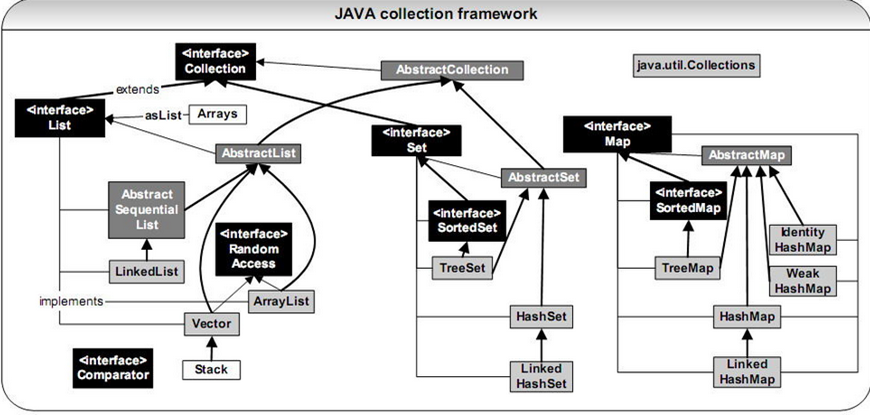
一、集合的体系结构

Collection是集合的基类,List和Set均继承自该类。在使用上,List:有序(元素存入集合的顺序和取出的顺序一致),元素都有索引,元素可以重复,而Set中元素要保证不能重复。Map集合存储和Collection有着很大不同: (1)Collection一次存一个元素;Map一次存一对元素。

(2)Collection是单列集合;Map是双列集合。

(3)Map中的存储的一对元素:一个是键,一个是值,键与值之间有对应(映射)关系。

二、Set和Map的关系,以及Map和List的关系

以HashMap为例,k-v键值对以Entry的方式存入了它的数据成员table,这个table我们可以认为它就是一个Set,因为这个table中的元素是彼此不相等; 反过来说,Set中的元素有一个索引与之对应,所以从这个角度看Set也是Map,而且我们可以从HashSet的实现看到,HashSet其实是通过HashMap来实现的; Map和List的关系,与Map和Set的关系类似。

三、ArrayList

(1)使用场景

继承自List,内用Object[]数组存放数据,封装对数组的操作,动态扩容,频繁的增(超出capacity则需要System.arraycopy,指定插入位置必执行System.arraycopy)删(每次删除都要System.arraycopy)影响性能,查询优势。当你需要一个数据结构存储数据,少增删多查询,可以使用ArrayList。

(2)源码解读

ArrayList的add/remove/subList代码解读:

1
2
3
4
5
6
7
8
9
10
11
12
13
14
15
16
17
18
19
20
21
22
23
24
25
26
27
28
29
30
31
32
33
34
35
36
37
38
39
40
41
42
43
44
45
46
47
48
49
50
51
52
53
public boolean add(E e) {
/*内部方法,计数并判断是否需要扩容
如果elementData已满,增加其大小至elementData.length + DEFAULT_CAPACITY
     */
        ensureCapacityInternal(size + 1);
elementData[size++] = e;
  //永远返回true,对于错误情况总是抛出异常
        return true;
    }

删除:
public E remove(int index) {
  //如果传入的index大于elementData存储总数,抛IndexOutOfBoundsException
        rangeCheck(index);
  //修改记录数,为做同步检查
        modCount++;
        E oldValue = elementData(index);
  //需要移动的数量。影响的是index之后的所有数据
        int numMoved = size - index - 1;
  //如果移除的是最后一位,就没有必要重新拷贝。
        if (numMoved > 0)
            System.arraycopy(elementData, index+1, elementData, index,numMoved);
  //把多余的最后一位清空,GC会回收
        elementData[--size] = null;
        return oldValue;
}

SubList(代码比较长,摘取部分)
  //constructor
SubList(AbstractList<E> parent,
                int offset, int fromIndex, int toIndex) {
      this.parent = parent; //将当前arraylist以参数形式传给subList
      this.parentOffset = fromIndex;
      this.offset = offset + fromIndex;
      this.size = toIndex - fromIndex; //记录sublist的size,与parent分开处理
      this.modCount = ArrayList.this.modCount; //防控并发修改
}
public E set(int index, E e) {
      rangeCheck(index); //sublist自身的方法,将index与sublist的size做比较
      checkForComodification(); //只检查了ModCount,没有变更。Set不是结构性变更,所以不用更改modCount。
      E oldValue = ArrayList.this.elementData(offset + index);
      ArrayList.this.elementData[offset + index] = e; //直接修改父类的数据
      return oldValue;
}
//对于sublist的add方法,必须指定index
  public void add(int index, E e) {
        rangeCheckForAdd(index);
        checkForComodification();
        parent.add(parentOffset + index, e);//调用parent对象的add方法完成此操作,因此父类数据也会被修改。
        this.modCount = parent.modCount;//add是结构性的更变,需要修改modCount。
        this.size++;
    }

初始capacity为10, 视应用情况使用ensureCapacity为数组扩容,减少System.arraycopy的次数。

四、HashMap

HashMap是线程不安全的 HashTable是线程安全的,但是粒度很大 ConcurrentHashMap, 线程安全,粒度比较小 利用segment缩小锁的范围

(1)、从HashMap的结构可以看出,HashMap的设计初衷是想结合链表和线性表的优势而达到较平衡的查询、添加和删除性能。

(2)、源码分析

Hash方法中,hashcode 的高位参加 hash计算,这样计算出来的hash值可以最大限度的体现对象之间的差异,目的是将对象放在不同的数组位置上。

Index方法中,对hash取模操作,这里的magic是length的长度是2的幂数,length-1后二进制都是01111…1, 从而可以快速取模。

1
2
3
4
5
6
7
8
static int hash(int h) {
    h ^= (h >>> 20) ^ (h >>> 12);
    return h ^ (h >>> 7) ^ (h >>> 4);
}

static int indexFor(int h, int length) {
    return h & (length-1);
}

GET取出的过程 1 判断key是不是为空,为空的话,默认在table[0]这个链表里找; 2 key非空的话,通过对hashcode进行hash,算出最终的hash值; 3 通过indexfor方法找到对应的链表table[i]; 4 在链表里,通过比较对象的hash值和key值。如果完全相同的话,返回对象。如果没有找到,返回null。

1
2
3
4
5
6
7
8
9
10
11
12
13
14
15
16
17
public V get(Object key) {
    if (key == null)
        return getForNullKey();
    int hash = hash(key.hashCode());
    for (Entry<K,V> e = table[indexFor(hash, table.length)];
        e != null;
        e = e.next) {
        Object k;
        if (e.hash == hash && ((k = e.key) == key || key.equals(k)))
            return e.value;
    }
    return null;
}

static int indexFor(int h, int length) {
    return h & (length-1);
}

(3)、Fail-first机制

HashMap不是线程安全。HashMap中有个成员变量modCount用来计算保障当前的map数据没有其它线程在同时修改。 如果有多个线程同时修改,会抛出ConcurrentModificationException看如下代码,用hashiterator方法来遍历map的时候, expectedModCount会被赋予最新的modCount值,调用nextEntry时,检查modCount值相等则不会报错。 调用iterator的remove方法,会让modCount加1,同时expectedModCount也被更新到最新。 所以下次在调用nextEntry时,连个值还是相等的。

1
2
3
4
5
6
7
8
9
10
11
12
13
14
15
16
17
18
19
20
21
22
23
24
25
26
27
28
29
30
31
32
33
34
35
36
     HashIterator() {
        expectedModCount = modCount;
        if (size > 0) { // advance to first entry
            Entry[] t = table;
            while (index < t.length && (next = t[index++]) == null)
                ;
        }
    }

      final Entry<K,V> nextEntry() {
        if (modCount != expectedModCount)
            throw new ConcurrentModificationException();
        Entry<K,V> e = next;
        if (e == null)
            throw new NoSuchElementException();

        if ((next = e.next) == null) {
            Entry[] t = table;
            while (index < t.length && (next = t[index++]) == null)
                ;
        }
        current = e;
        return e;
    }

    public void remove() {
        if (current == null)
            throw new IllegalStateException();
        if (modCount != expectedModCount)
            throw new ConcurrentModificationException();
        Object k = current.key;
        current = null;
        HashMap.this.removeEntryForKey(k);
        expectedModCount = modCount;
    }

五、HashSet

HashSet 不会保证iterable的顺序,LinkedHashSet会保证插入的顺序跟你的iterable的顺序一样 两条规则实现hashCode()在classes: 1.如果object1 和 object2 equals(),那么他们2个应该有相同的hashcode 2.如果object1 和 object2 有一样的hashcode,那么他们不一定会equal.

HashSet源码解读

1
2
3
4
5
6
7
8
9
10
11
12
13
14
15
16
17
18
19
20
21
22
23
24
25
26
27
28
29
30
31
32
33
34
35
36
37
38
39
40
41
42
43
44
45
46
47
48
49
50
51
52
53
54
55
56
57
58
59
60
61
62
63
64
65
66
67
68
69
70
71
72
73
74
75
76
77
78
79
80
81
82
83
84
85
86
87
88
89
90
91
92
93
94
95
96
97
98
99
100
public class HashSet<E>
    extends AbstractSet<E>
    implements Set<E>, Cloneable, java.io.Serializable
{
    static final long serialVersionUID = -5024744406713321676L;

    //使用HashMap的key保存HashSet中的所有元素
    private transient HashMap<E,Object> map;

    // Dummy value to associate with an Object in the backing Map
    //定义一个虚拟的Object对象作为HashMap的value
    private static final Object PRESENT = new Object();

    /**
     * Constructs a new, empty set; the backing <tt>HashMap</tt> instance has
     * default initial capacity (16) and load factor (0.75).
     */
     //初始化HashSet,底层会初始化一个HashMap
    public HashSet() {
    map = new HashMap<E,Object>();
    }
//指定初始容量和loadfactor来初始化HashSet,其实就是初始化HashMap
     //loadfactor = 散列表的实际元素数目(n)/ 散列表的容量(m)
    public HashSet(int initialCapacity, float loadFactor) {
    map = new HashMap<E,Object>(initialCapacity, loadFactor);
    }

    /**
     * Constructs a new, empty set; the backing <tt>HashMap</tt> instance has
     * the specified initial capacity and default load factor (0.75).
     *
     * @param      initialCapacity   the initial capacity of the hash table
     * @throws     IllegalArgumentException if the initial capacity is less
     *             than zero
     */
    public HashSet(int initialCapacity) {
    map = new HashMap<E,Object>(initialCapacity);
    }

    /**
     * Constructs a new, empty linked hash set.  (This package private
     * constructor is only used by LinkedHashSet.) The backing
     * HashMap instance is a LinkedHashMap with the specified initial
     * capacity and the specified load factor.
     *
     * @param      initialCapacity   the initial capacity of the hash map
     * @param      loadFactor        the load factor of the hash map
     * @param      dummy             ignored (distinguishes this
     *             constructor from other int, float constructor.)
     * @throws     IllegalArgumentException if the initial capacity is less
     *             than zero, or if the load factor is nonpositive
     */
    HashSet(int initialCapacity, float loadFactor, boolean dummy) {
    map = new LinkedHashMap<E,Object>(initialCapacity, loadFactor);
    }

    /**
     * Returns an iterator over the elements in this set.  The elements
     * are returned in no particular order.
     *
     * @return an Iterator over the elements in this set
     * @see ConcurrentModificationException
     */
     //调用Map的keyset来返回迭代器
    public Iterator<E> iterator() {
    return map.keySet().iterator();
    }
/**
     * Adds the specified element to this set if it is not already present.
     * More formally, adds the specified element <tt>e</tt> to this set if
     * this set contains no element <tt>e2</tt> such that
     * <tt>(e==null&nbsp;?&nbsp;e2==null&nbsp;:&nbsp;e.equals(e2))</tt>.
     * If this set already contains the element, the call leaves the set
     * unchanged and returns <tt>false</tt>.
     *
     * @param e element to be added to this set
     * @return <tt>true</tt> if this set did not already contain the specified
     * element
     */
     //将e作为key插入了Hashmap
    public boolean add(E e) {
    return map.put(e, PRESENT)==null;
    }
/**
     * Returns a shallow copy of this <tt>HashSet</tt> instance: the elements
     * themselves are not cloned.
     *
     * @return a shallow copy of this set
     */
     //拷贝通过两步完成:1、通过调用super.clone完成父类的拷贝;2、通过调用map.clone()完成对成员变量map的拷贝。注意map的拷贝也是调用super.clone完成,所以拷贝都是浅拷贝。另外需要注意拷贝过程会抛出CloneNotSupportedException异常,这是一个检查异常。
    public Object clone() {
    try {
        HashSet<E> newSet = (HashSet<E>) super.clone();
        newSet.map = (HashMap<E, Object>) map.clone();
        return newSet;
    } catch (CloneNotSupportedException e) {
        throw new InternalError();
    }
    }

六、ArrayList vs LinkedList

ArrayList,实现是一个数组,动态扩容,每次当超出capacity, 就把数组的size扩大,然后把以前的内容copy到新的数组里面去。

ArrayList 如何实现的fail-fast策略,是在每个对于ArrayList结构发生变化的方法里面(比如:add, remove),都有个modCount这样的变量来记录,然后在iterator里面,构造iterator时候,把modcount 赋值给 exceptCount, 然后check是否相等这2个变量。

LinkedList, 实现是一个双向链表。

            ArrayList,      LinkedList

Get(index) O(1) O(n) Add O(1) O(1) Remove O(n – index) O(1) Fail-fast的实现,modifyCount != exceptiedCount. 它们2个都是线程不安全的。

七、好的实践

使用LinkedHashMap构建LRU缓存

(1) LRU缓存 我们用缓存来存放以前读取的数据,而不是直接丢掉,这样,再次读取的时候,可以直接在缓存里面取,而不用再重新查找一遍,这样系统的反应能力会有很大提高。但是,当我们读取的个数特别大的时候,我们不可能把所有已经读取的数据都放在缓存里,毕竟内存大小是一定的,我们一般把最近常读取的放在缓存里。 LRU缓存利用了这样的一种思想。LRU是Least Recently Used 的缩写,翻译过来就是“最近最少使用”,也就是说,LRU缓存把最近最少使用的数据移除,让给最新读取的数据。而往往最常读取的,也是读取次数最多的,所以,利用LRU缓存,我们能够提高系统的性能。 (2) 为什么是LinkedHashMap 第一,它的数据结构包含一个双向链表,其源代码片段如下:

1
2
3
4
5
6
7
8
9
10
11
12
public class LinkedHashMap<K,V>  extends HashMap<K,V>  implements Map<K,V> {
    /**
     * The head of the doubly linked list.
     */
    private transient Entry<K,V> header;
其中Entry的定义的代码片段如下:
/**                                                                       
 * LinkedHashMap entry.                                                   
 */
private static class Entry<K,V> extends HashMap.Entry<K,V> {
    // These fields comprise the doubly linked list used for iteration.   
    Entry<K,V> before, after;

可见这个双向链表就具备了实现LRU的基础,每次访问LinkedHashMap里的元素或者向LinkedHashMap里添加元素时,都会更新这个双向链表,让其header永远指向最少使用的元素,其代码实现可以参考LinkedHashMap的源代码。 第二,LinkedHashMap本身有一个方法用于判断是否需要移除最少使用的元素,但是,原始方法默认不需要移除,该方法实现的源代码如下:

1
2
3
protected boolean removeEldestEntry(Map.Entry<K,V> eldest) {
        return false;
}


实际使用中,可以将header指向的最少使用的元素作为该方法的入参,然后重写方法 removeEldestEntry,可以根据自己的条件来决定是否删除该元素。 (3) 实现样例 基于以上的分析,下面给出一个简单的LUR缓存的实现样例,代码如下:

1
2
3
4
5
6
7
8
9
10
11
12
13
14
15
16
17
18
19
20
21
22
23
24
25
26
27
28
29
30
31
32
33
34
35
36
37
38
39
40
41
42
43
44
45
46
47
48
49
public class LRULinkedHashMap<K, V> extends LinkedHashMap<K, V> {
  /** serialVersionUID */
  private static final long serialVersionUID = -5933045562735378538L;
  /** 最大数据存储容量 */
  private static final int LRU_MAX_CAPACITY = 1024;
  /** 剩余内存空间的阈值,设置的为50M */
  private static final int SPACE_THRESHOLD = 50 * 1024 * 1024;
/** 存储数据容量 */
  private int capacity;
  public LRULinkedHashMap() {
      super();
  }

  /**
     * 带参数构造方法
     * 
     * @param initialCapacity 容量
     * @param loadFactor 装载因子
     * @param isLRU 是否使用lru算法,true:使用(按方案顺序排序);false:不使用(按存储顺序排序)
     */
  public LRULinkedHashMap(int initialCapacity, float loadFactor, boolean isLRU) {
      super(initialCapacity, loadFactor, true);
      capacity = LRU_MAX_CAPACITY;
  }

  /**
     * 带参数构造方法
     * 
     * @param initialCapacity 容量
     * @param loadFactor 装载因子
     * @param isLRU 是否使用lru算法,true:使用(按方案顺序排序);false:不使用(按存储顺序排序)
     * @param lruCapacity  lru存储数据容量
     */
  public LRULinkedHashMap(int initialCapacity, float loadFactor,
          boolean isLRU, int lruCapacity) {
      super(initialCapacity, loadFactor, true);
      this.capacity = lruCapacity;
  }

  @Override
  protected boolean removeEldestEntry(Entry<K, V> eldest) {
      if (capacity > 0 && size() > capacity) {
          return true;
      } else if (Runtime.getRuntime().freeMemory() < SPACE_THRESHOLD) {
          return true;
      }
      return false;
  }
  }